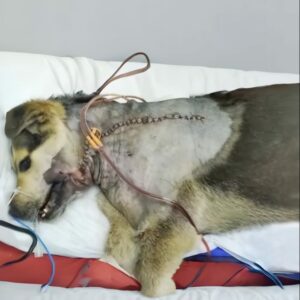
When Benki was found, it wasn’t his injuries that stood out first.
It was his stillness.
On a quiet day in Lara, Venezuela, rescuers noticed a small dog standing alone, unmoving, as if the world around him no longer required a response. He didn’t turn his head when footsteps approached. He didn’t tense or retreat. He remained exactly where he was, frozen—not from defiance, but from uncertainty.
Only when they came closer did the full picture begin to emerge.
Benki could not see them. One of his hind legs was gone. And his body bore marks that spoke of a long history of neglect rather than a single moment of misfortune. Yet even then, he did not react with aggression. What came instead were soft, distressed sounds—calls not meant to threaten, but to locate reassurance in a space that had become unfamiliar and overwhelming.
Veterinary examinations later confirmed what his body already suggested: Benki’s suffering had not been accidental. His injuries aligned with prolonged exploitation, likely tied to breeding practices where value ends the moment usefulness does. And yet, beneath the damage, something remained intact. His internal organs were healthy. His heart and lungs were strong. His body, though altered, was still capable of healing.
What required the most care, however, was not visible on an X-ray.
Benki was blind, disoriented, and deeply unsure of his surroundings. Sound replaced sight, but unfamiliar noises triggered panic rather than guidance. In those early days, treatment took a back seat to presence. Caregivers sat with him for hours, speaking softly, repeating the same tones and words, allowing him to associate voices with safety instead of threat.
Nothing was rushed.
Benki was never pulled forward. He was invited.
Gradually, patterns formed. The same voices at feeding time. The same gentle cues before movement. The same calm hands guiding him through short distances. This consistency became his map. About ten days into care, something shifted. Benki began responding. He paused when spoken to. He moved when guided. It was subtle—but it meant he was listening, processing, trusting.
As weeks passed, his world expanded.
With careful support, Benki stepped beyond the enclosure he had learned to recognize. His movements were cautious, deliberate. He relied on sound, scent, and touch to orient himself. Each step carried hesitation, but also curiosity. Fear no longer controlled every decision.
To help him navigate more confidently, caregivers introduced protective eyewear designed for visually impaired dogs. The change was immediate. Obstacles felt less threatening. Exploration became less tense. The simple act of moving forward no longer carried the same level of risk.
Life in recovery brought new challenges. Limited mobility led to weight gain, so activity was reintroduced thoughtfully. Short stair exercises. Guided walks. Gentle play adapted to his abilities. These routines strengthened his body, but more importantly, they strengthened his engagement with the world.
What surprised everyone most was Benki himself.

Despite everything he had endured, he did not withdraw. He leaned into touch. He sought human presence. He rested more easily when voices were nearby. The dog who once cried out in confusion now responded with calm affection, his body language softening day by day.
Healing revealed his nature.
Benki was gentle. Patient. Quietly resilient.
He had been treated as expendable—valued only for what he could produce, discarded when he no longer served a purpose. Yet given time, care, and understanding, he rediscovered joy. Not loud or dramatic joy, but something steadier: comfort, trust, belonging.
Today, Benki is ready for a permanent home. His needs are specific, but his capacity for connection is extraordinary. He listens closely. He responds deeply. He offers a kind of loyalty that comes not from dependence, but from gratitude.
His story is not defined by what he lost.

It is defined by what remained.
A heart capable of trust. A mind willing to adapt. A spirit that, once given safety, chose hope.
Benki stands as a reminder that healing is not about restoring what was taken, but about building something new in its place. And when compassion is consistent, even lives shaped by darkness can learn to feel safe again.
That is Benki’s journey.
And it is still unfolding.